Highway safety engineers and road infrastructure contractors worldwide are increasingly replacing traditional W-beam and concrete barriers with advanced energy-absorbing systems. Among these innovations, the rolling barrier guardrail (also known as a roller crash barrier or safety roller barrier) has emerged as one of the most effective solutions for preventing fatal accidents on sharp curves, bridges, and high-risk highway sections.
However, when specifying these systems for international road projects, a critical question frequently arises: What is the highest standard for a roller barrier system, and how do standards compare across different countries?
In this comprehensive guide, we analyze global crash-test standards, identify the highest achievable containment levels, and explain why choosing a certified rolling barrier guardrail manufacturer is essential for infrastructure safety.
Understanding the Working Mechanism of Rolling Barrier Guardrails
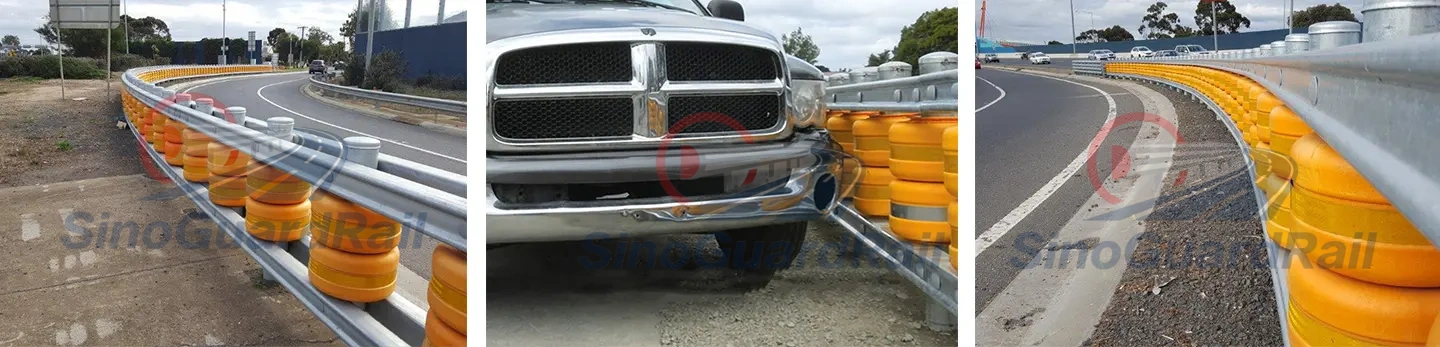
Before examining crash test levels, it is important to understand why the rolling barrier guardrail outperforms conventional barriers. Unlike static barriers that absorb impact solely through deformation or rigid redirection, the roller barrier integrates high-elasticity EVA (Ethylene-Vinyl Acetate) or Polyurethane (PU) rotating barrels mounted on heavy-duty galvanized steel posts.
Impact Energy Conversion: It converts direct linear collision impact into rotational kinetic energy.
Trajectory Correction: It smoothly redirects out-of-control vehicles back into the normal flow of traffic, preventing secondary rebounds or rollover incidents.
High Visibility & Low Maintenance: Bright rotating drums with 3M reflective sheeting provide 24/7 visual guidance while modular components allow quick single-part replacement after impact.
Global Standards for Rolling Barrier Guardrails: Country Breakdown
Different regions evaluate road safety barriers using standardized full-scale vehicle crash tests. The main international standards governing roller crash barriers include:
1. United States: AASHTO MASH & NCHRP Report 350
In North America, the AASHTO Manual for Assessing Safety Hardware (MASH) is the benchmark (superseding NCHRP 350):
MASH TL3 (Test Level 3): Evaluates small passenger cars (1,100 kg) and pickup trucks (2,270 kg) impacting at 100 km/h (62 mph) at an angle of 25 degrees.
MASH TL4 (Test Level 4): Adds a single-unit commercial truck test (10,000 kg / 22,000 lbs) at 90 km/h (56 mph) at 15 degrees, in addition to passenger vehicle tests.
2. European Union: EN 1317 (Containment Levels)
In Europe and CE-marked territories, containment levels are categorized by impact severity and vehicle weight under EN 1317-2:
N1 / N2 (Normal Containment): Passenger cars at 80–110 km/h.
H1 / L1 (High Containment): 10-tonne rigid truck at 70 km/h and 1,500 kg car at 110 km/h.
H2 / L2 (Higher Containment): 13-tonne bus at 70 km/h (20°) and 900 kg car at 100 km/h.
H4b (Very High Containment): 38-tonne articulated heavy goods vehicle (HGV) at 65 km/h (primarily reserved for rigid concrete structures).
3. China: GB/T & JTG D81 (Highway Safety Barrier Standards)
China's standard classifies containment levels into graded energy levels (measured in kJ):
Level B / A: Basic highway and rural road protection (40–160 kJ).
Level SB / SA: High-speed expressways and major trunk roads (280–400 kJ).
Level SS / HA: Extra-heavy protection (400–640+ kJ) for hazardous mountain cliffs and bridge overpasses.
4. Australia & New Zealand: AS/NZS 3845
Australia adheres closely to MASH and EN 1317 harmonization, mandating MASH TL3 or TL4 compliance for major state road authorities (such as Transport for NSW and VicRoads).
Which Country Has the Highest Standard for Rolling Barriers?
When asking "What is the highest level for a roller barrier?", we must distinguish between standard stringency and product engineering capabilities:
| Standard Category | Highest Commercial Roller Barrier Rating | Target Impact Vehicles Tested |
|---|---|---|
| USA (AASHTO MASH) | MASH TL4 (Highest Standard Rating) | 10,000 kg Truck + 2,270 kg Pickup + 1,100 kg Sedan |
| Europe (EN 1317) | EN 1317 H2 | 13,000 kg Bus + Passenger Cars |
| China (JTG Standard) | Grade SB / SA / SS | Heavy duty freight vehicles & commercial buses |
Conclusion on Highest Level:
Currently, AASHTO MASH TL4 (USA) and EN 1317 H2 (Europe) represent the highest internationally verified and practically implemented crash test standards for rolling barrier systems worldwide. Meeting MASH TL4 proves that the safety roller system can safely redirect medium-duty trucks and commercial freight without barrier rollover, structural breach, or hazardous vehicle redirection.
Key Features to Look for in a Premium Rolling Barrier Manufacturer
For municipal highway projects, toll roads, and international bidding, sourcing directly from an experienced manufacturer ensures both regulatory compliance and cost efficiency. High-quality rolling barriers must feature:
High-Elasticity EVA Rollers: Virgin material formulation resistant to UV degradation, chemical corrosion, and extreme weather (-40°C to +70°C).
Hot-Dip Galvanized Structural Steel: Posts and cross beams compliant with ASTM A123 / ISO 1461 to guarantee 20+ years of anti-corrosion life.
Modular Component Flexibility: Easy installation around tight radii and variable post spacings (0.7m to 1.0m center-to-center).
Complete Crash Test Verification: Certified test reports matching MASH, EN1317, or regional highway engineering requirements.
Get Certified Highway Rolling Barrier Guardrails from Sino Guardrail
As a leading global provider of highway safety infrastructure, Sino Guardrail manufactures and supplies high-performance rolling barrier guardrails, standard W-beam crash barriers, and customized roadside safety systems.
Whether you need MASH TL3/TL4 compliant roller barriers for highway interchange ramps, mountain highways, or bridge approaches, our engineering team provides complete technical drawings, competitive factory pricing, and full certification support.
Contact our highway safety specialists today at www.sinoguardrail.com to request technical specifications and a factory-direct quote.