Highway Guardrail Maintenance and Repair Guide
A practical inspection and repair checklist for steel highway guardrail systems, covering rails, posts, connections, terminals, corrosion, drainage and post-impact replacement decisions.
1. When Should a Guardrail Be Inspected?
Follow the inspection schedule set by the road owner or maintenance contract. In addition to scheduled work, arrange a condition check when one of these events occurs:
After an Impact
Check the rail line, posts, connections, terminals and the surrounding ground before the affected section is returned to normal service.
After Weather or Drainage Events
Check for erosion, washout, standing water, slope movement, frost-related displacement or loss of support around posts.
After Roadworks
Review rail height, post exposure, drainage and terminal interfaces after resurfacing, widening, utility work or shoulder repair.
2. Start with the Whole Barrier Line
Walk or drive the barrier section in a safe, approved manner and look for changes in continuity. A guardrail is a connected system: a problem at a splice, post, terminal or transition can affect the way the section performs as a whole.
- Rail alignment: look for abrupt changes in height, horizontal line, overlap direction, twisting or residual deformation.
- Mounting height: compare the top-of-rail position with the approved drawing, especially after resurfacing or shoulder works.
- Rail continuity: check that adjacent panels overlap and connect as required, with no open joints or missing sections.
- Terminals and transitions: inspect the start, end and changes between guardrail types, bridge rails, concrete barriers or other roadside structures.
- Clear zone: remove debris, stored materials or vegetation that obstructs access, hides damage or interferes with the intended layout.
3. Inspect Rails, Posts and Connections Together
| Component | Check for | Repair Decision |
|---|---|---|
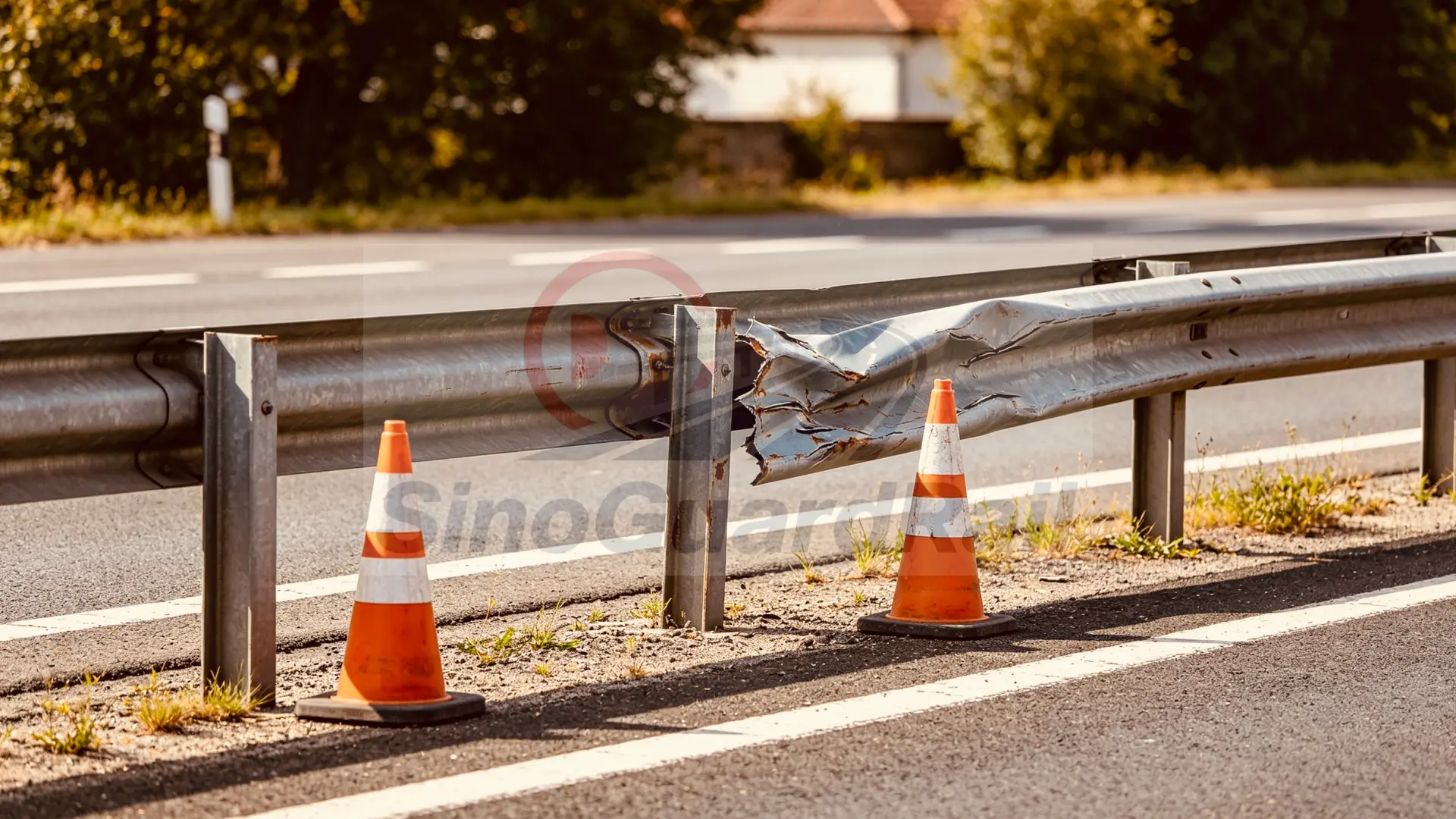
| W-beam or thrie-beam rail | Bends, tears, sharp edges, failed splices, damaged slots, missing sections or excessive misalignment. | Use the authority’s criteria and original system drawing to determine replacement scope. Do not assume a visibly straight rail is still acceptable. |
| Posts and foundations | Lean, buckling, rotation, loss of support, exposed foundation, damaged base plate, cracked concrete or disturbed soil. | Restore with the specified post, embedment or anchoring arrangement. Site conditions may require engineering review before replacement. |
| Spacers and blockouts | Cracking, crushing, deformation, missing parts, incorrect orientation or contact between rail and post where a spacer is required. | Replace with the same approved type and verify its position before final tightening. |
| Bolts, nuts and washers | Missing or sheared fasteners, thread damage, corrosion, loose connections, incorrect bolt orientation or incompatible replacement hardware. | Use the specified bolt set and installation procedure. Apply torque only to the required project or authority instruction. |
| Terminal and transition | Loose anchors, damaged end components, open joints, changed ground level or damage at bridge and concrete interfaces. | Repair as the complete approved terminal or transition arrangement, not as an isolated rail substitution. |
4. Corrosion, Coating and Drainage Checks
Hot-dip galvanized steel slows corrosion, but coating condition still needs inspection. Pay particular attention to cut edges, holes, splices, rail-to-spacer contact areas, damaged coating, coastal exposure, de-icing salt zones and places where soil or water remains in contact with steel.
- Distinguish surface marks from base-metal exposure: identify whether the zinc layer is weathering, whether there is local coating damage, or whether red rust indicates exposed steel.
- Check drainage first: recurring water, blocked outlets, splash zones and soil buildup can continue damaging a repaired surface.
- Use an approved repair system: any coating touch-up or replacement must follow the authority’s specification and the original coating requirement.
- Do not hide structural damage with paint: a coating repair does not correct a bent rail, damaged post, torn slot or failed connection.
5. Post-Impact Assessment and Replacement
After an impact, establish traffic control under the approved site procedure before personnel inspect the barrier. Photograph the condition, identify the affected limits and compare the required replacement parts with the current drawing and bill of quantities.
- Secure the work area: use the authority’s traffic-management requirements and restrict access where the barrier condition creates a roadside hazard.
- Check beyond the visible impact point: adjacent splices, posts, spacers, terminals and foundations can also be affected.
- Identify exact replacement parts: match rail profile, thickness, length, hole pattern, coating, post type, hardware and transition details to the approved system.
- Do not heat, hammer or bend structural parts back into shape unless the responsible authority’s approved procedure specifically permits it.
- Verify the completed repair: check rail line, fastener installation, terminal or transition continuity, ground condition and any required inspection before reopening.
6. Roller Barrier Maintenance: Check the Complete Assembly
For a safety roller barrier system, inspect the rotating barrels, posts, upper and lower rails or support members, connectors, fasteners, terminals and reflective elements as a coordinated assembly. Replacement components must match the approved layout.

- Remove debris that obstructs components or drainage around the system.
- Check barrels for cracking, severe abrasion, deformation or damage to reflective elements.
- Check that posts, rails, connectors and terminal parts remain connected according to the approved assembly.
- Where the approved configuration requires barrel rotation, investigate restricted movement rather than forcing a damaged component.
- Use matching barrels, connectors and fasteners for replacement; do not mix unverified parts from a different layout.
7. Maintenance Spare-Parts Checklist
Before ordering replacements, prepare a clear site note and confirm the part details. This avoids receiving a visually similar component that does not fit the installed system.
- Road or asset reference, location and photographs showing the damaged area
- Original or current approved drawing and relevant BOQ line items
- Rail profile, dimensions, hole pattern, finish and required quantity
- Post, spacer, blockout, backup plate and fastener details
- Terminal or transition details, including the adjoining barrier type
- Required coating, packing, inspection and delivery information
Frequently Asked Questions
Can a bent rail be straightened and reused?
Do not assume so. The responsible authority’s repair procedure and the approved system drawing determine whether a component may remain in service or must be replaced.
Why must rail height be checked after resurfacing?
A pavement overlay or shoulder change can alter the rail’s relative height. The completed rail line should be checked against the approved drawing.
Can ordinary hardware replace a missing guardrail bolt?
No. Replacement bolts, nuts and washers must match the specified system hardware and installation requirement.
Can a roller barrier barrel be replaced separately?
A barrel can be ordered as a spare part when its dimensions, material, connection arrangement and layout match the approved system. Check adjacent components after an impact as well.
Need Matching Guardrail Repair Parts?
Send photos, the current drawing, damaged-part details, quantity, coating requirement and destination port. We can help identify matching rails, posts, spacers, hardware, terminals and roller barrier components for project review.
Request Spare Parts Chat on WhatsApp