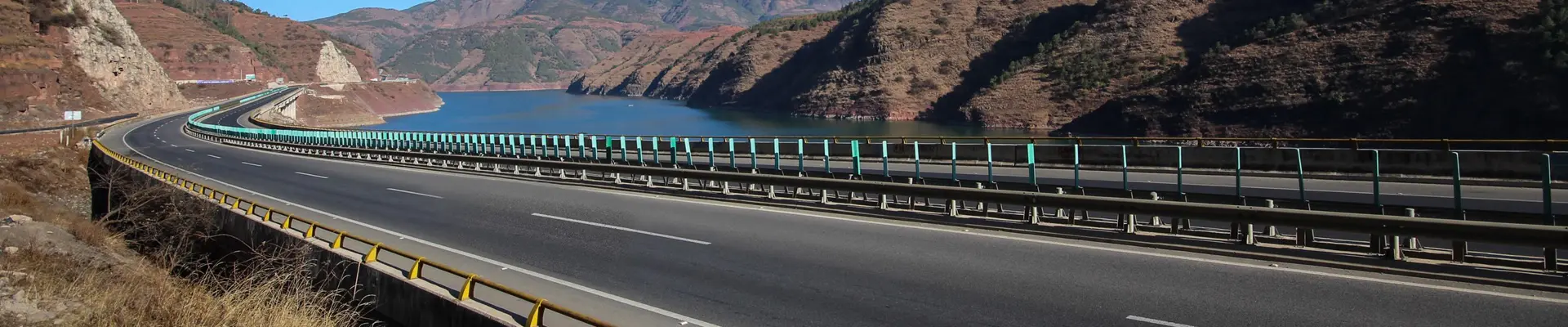
Choose a W-Beam guardrail configuration from the approved system drawing, not from a standard panel size or the lowest unit price. Confirm the governing specification, rail dimensions, steel, coating, posts, spacers, fasteners, terminals, transitions, installation conditions and inspection records together before purchasing. The project engineer must approve the final barrier system.
Overall beam length and effective installed coverage are different values.
Rail thickness, steel grade and coating are separate purchasing requirements.
Posts, spacers, bolts, terminals and transitions must match the approved system drawing.
AASHTO M180 beam requirements do not by themselves establish complete barrier-system performance.
Project documents and the responsible engineer govern final acceptance.
Conclusion: Select the W-Beam arrangement specified by the approved drawing and procure the matching components as one complete system.
Applicable conditions: The required dimensions, steel, coating, posts, terminals and installation layout depend on the project standard, road environment and site design.
Evidence: Verify the drawing, BOQ, material records, coating inspection method, component schedule and approved documentation before production and shipment.
Exception: A catalog dimension or a compatible-looking rail is not sufficient when it differs from the approved configuration or lacks the required project documentation.
Reference basis: AASHTO M180, corrugated sheet-steel guardrail beam specification.Confirm the applicable edition, authority requirements and complete-system documentation in the project documents.
Choosing a W-beam guardrail is a system-design decision, not simply a comparison of beam prices. The correct configuration depends on the project standard, approved drawings, beam length and thickness, coating requirement, post and spacer arrangement, terminals, transitions and site conditions.
This guide explains the information contractors, distributors and procurement teams should confirm before requesting a quotation. For drawing-based production, steel-grade options and quotation requirements, review our custom W-beam guardrail manufacturer page and send us your drawings or bill of quantities (BOQ).
Confirm the governing standard and approved project drawing.
Confirm overall length, effective length, thickness and hole pattern.
Specify the required steel grade and surface treatment.
Match the beam with the correct posts, spacers, bolts and terminals.
Provide site conditions, quantities, packing requirements and delivery destination.
The tender specification and approved engineering drawing must come first. A project may refer to AASHTO M180, a national highway authority specification or another local requirement. Do not select a rail only because its general dimensions appear similar to a previous project. Beam profile, steel properties, coating, splice arrangement, hole locations and compatible system components must be checked together.
When the specification is incomplete, ask the project engineer to confirm the required system before ordering. A manufacturer can review production feasibility, but the final roadside barrier configuration should follow the design approved for that project.
Overall length is the full manufactured length of one beam. Effective length is the installed coverage after adjacent beams overlap. Confusing these two values can produce incorrect quantity calculations, post spacing assumptions and container plans.
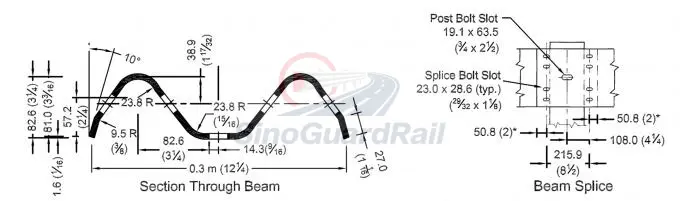
The following dimensions are reference options shown in an AASHTO M180 W-beam product record. They are not a substitute for the dimensions stated in your tender or drawing.
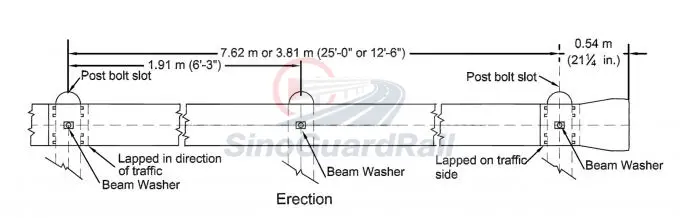
The drawings below illustrate the lap direction, W-beam profile and splice-hole arrangement. Dimensions printed in these drawings belong to the illustrated configuration and should not be treated as the order dimensions for every project. Confirm all dimensions against the approved project drawing.
| Reference Type | Overall Length | Effective Length | Nominal Uncoated Thickness |
|---|---|---|---|
| Type I | 4130 mm | 3810 mm | 2.67 mm |
| Type II | 4320 mm | 4000 mm | 2.67 mm |
Reference values must be reconfirmed against the purchase specification. Custom length and thickness may be available when supported by the project requirements and production review.
Available W-beam product records include base-metal thicknesses from 2.5 mm to 4.0 mm, while the AASHTO reference options above use a nominal uncoated thickness of 2.67 mm. These figures describe different product options and should not be treated as interchangeable.
The required thickness should be taken from the project specification. Increasing or reducing thickness without engineering approval can change system behavior, weight, cost, connection details and installation requirements. For a comparison of common purchasing terms, read our W-beam thickness and specification guide.
W-beam product options may use Q235B or Q345B steel, depending on the requested configuration. The correct grade must be stated in the tender, drawing or purchase order. If a project names another grade, provide the complete mechanical-property requirements rather than relying only on an assumed grade equivalence.
Your inquiry should identify the steel grade, required test documents and any inspection requirement. This allows the manufacturer to confirm whether the requested material and documentation can be supplied before production.
Available surface-treatment options include hot-dip galvanizing and powder coating. A referenced W-beam record lists zinc coating options of 550 g/m2 or 1100 g/m2. The required coating should be selected from the project specification and the expected exposure environment, including coastal salt, humidity, industrial pollution and winter de-icing conditions.
State clearly whether the coating value applies to total zinc mass or another measurement basis used by the project. Also confirm the required inspection method and documentation. Avoid converting zinc mass into a claimed coating thickness unless the applicable standard and calculation basis are both defined.
A W-beam does not operate as an isolated component. The system can include posts, spacers or brackets, splice bolts, post bolts, nuts, washers, terminals, transition sections, reflectors and other accessories. The selected components must match the approved system drawing.
| Component | What to Confirm |
|---|---|
| W-beam rail | Profile, overall and effective length, thickness, hole pattern, steel grade and coating |
| Post | Profile, section size, length, thickness, spacing, embedment and coating |
| Spacer or bracket | Type, dimensions, hole locations and compatibility with the beam and post |
| Fasteners | Bolt type, diameter, length, strength grade, nut, washer and coating |
| Terminal and transition | Approved type, connection details, direction and location in the road layout |
Review available guardrail posts and guardrail accessories, then send the exact component schedule from your drawing for matching.
Road geometry and ground conditions affect the system layout. Include information about roadside or median installation, straight or curved sections, bridge approaches, slopes, soil or concrete foundations, traffic direction and any restricted working space. Curved beams, transitions and terminal arrangements should be identified on the drawings rather than added after production.
For rehabilitation projects, provide measurements and clear photos of the existing system. A visually similar rail does not guarantee that its hole pattern, lap direction or connection hardware will match the installed components.
Project country, governing standard and approved drawings
Beam type, overall length, effective length, thickness and hole pattern
Steel grade and required material documents
Surface treatment and zinc-coating requirement
Post, spacer, fastener, terminal and transition specifications
Quantity or complete BOQ
Inspection, marking and packing requirements
Destination port and requested delivery schedule
No. Length, effective coverage, thickness, hole pattern, steel grade and coating can vary by standard and project. Use the approved drawing as the purchasing basis.
Overall length is the full length of the manufactured rail. Effective length is the roadway coverage after adjacent rails overlap. Use effective length when estimating the number of beams, subject to the approved layout.
Referenced product data indicates that custom length and thickness are available. Production feasibility still needs to be confirmed against the drawings, quantity and required standard.
No. Confirm the complete system together so that beam holes, posts, spacers, bolts, terminals and transitions are compatible.
Follow the project specification and exposure requirements. Referenced options include 550 g/m2 and 1100 g/m2, but the required coating basis and inspection method must be stated in the order.
Send your standard, drawings, BOQ, coating requirement and destination. We will review the requested beam and matching components before quotation.
Send Your RFQFor drawings, BOQ-based purchasing and project-specific requirements, see our W-Beam guardrail supplier and product configurations.
Contact: Mr.Zhang
Phone: +86 13306356181
Email: [email protected]
Add: Guanxian Economic Development Zone, Liaocheng City, Shandong Province, China
We chat