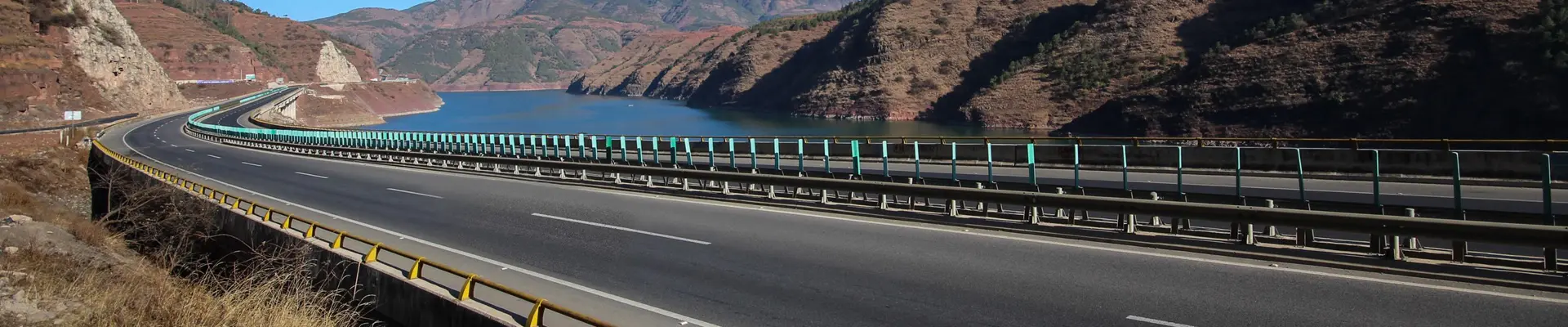
A Thrie-Beam guardrail is a three-wave corrugated-steel highway barrier used where a taller rail is needed than a standard W-beam. In the typical configuration described here, the rail is 510 mm wide and connects with matched posts, spacers and terminals for bridge approaches, medians, curves and other project-specific locations.
A Thrie-Beam profile has three corrugations; a W-beam profile has two.
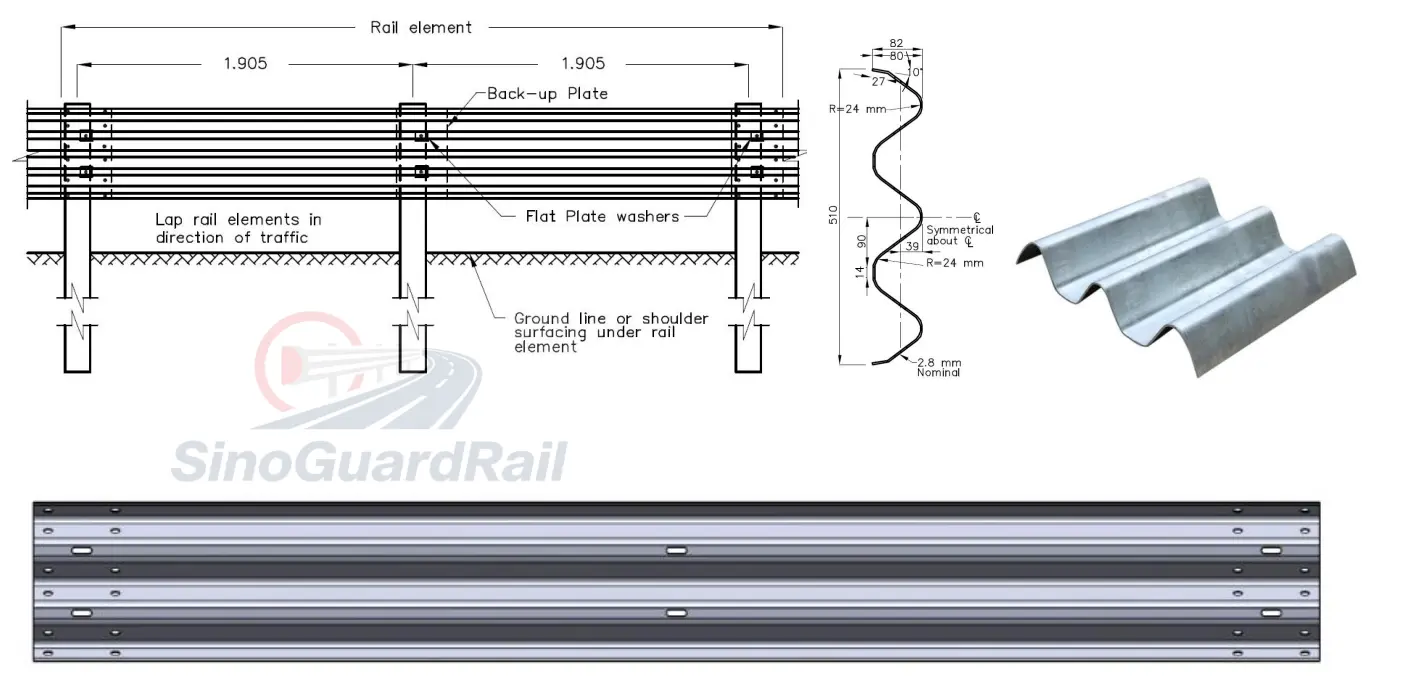
The typical rail example in this guide is 4,130 mm long and 510 mm wide.
A complete system can include rails, posts, spacers, backup plates, washers, bolts, terminals and transition pieces.
Bridge approaches, medians, curves and drop-off locations require project-specific barrier selection.
Final dimensions, materials, coating and installation details must follow project drawings and the applicable road authority requirements.
Conclusion: A Thrie-Beam guardrail is generally selected when a three-wave, taller barrier profile is appropriate for the road layout.
Applicable conditions: The selected configuration depends on vehicle risk, roadside geometry, bridge or median conditions, drawings and the governing specification.
Evidence: The dimensional examples and component list below describe a typical AASHTO M180-style reference configuration; the final project configuration must be confirmed against the applicable standard and approved drawings.
Exception: A W-beam or another barrier type may be more appropriate where the required containment, geometry or local authority specification differs.
If you've spent any time driving highways, you've seen those wavy steel beams running along the roadside. Most of them are the two-wave W-beam type. But every now and then you'll spot a bigger, beefier cousin - the thrie-beam guardrail. So what is it, and why should you care? In plain words, a thrie-beam guardrail is a three-wave highway safety barrier made from corrugated steel. It's taller and stiffer than a standard W-beam, which makes it the go-to pick when you need a bit more muscle - think sharp curves, medians, and bridge approaches. Below we'll walk through what it is, how it's built, how it stacks up against the W-beam, and where it actually gets used.
Let's start with the obvious question: what is a thrie beam guardrail in plain English? Take a flat steel strip, roll it into waves, and you get a guardrail. A W-beam has two waves. A thrie-beam - sometimes written "three-beam" - has three. That extra wave might not sound like much, but it makes the beam about 200 mm taller and noticeably stiffer.
Why does that matter? When a car hits a barrier, you want the beam to catch the vehicle low and redirect it, not let it climb over. The taller thrie-beam grabs higher up on the vehicle body, so it holds bigger vehicles - vans, SUVs, small trucks - more securely. It's the same idea as the W-beam, just turned up a notch. Our Thrie-beam guardrail product specifications follow this exact profile.
This is the question almost everyone asks first. They do the same job; they just fit different places. Here's the short version:
| Feature | W-Beam | Thrie-Beam |
|---|---|---|
| Waves | 2 | 3 |
| Width | ~310 mm | 510 mm |
| Height / stiffness | Standard | Taller & stiffer |
| Best for | Standard roadside | Curves, medians, bridge ends |
| Cost | Lower | A bit higher |
Neither one is "better" across the board. The W-beam wins on price for long straight runs. The thrie-beam guardrail earns its keep on the trickier sections where you don't want a vehicle climbing over the top.
Enough theory. Here are the actual numbers from a typical thrie beam guardrail specification we build to (AASHTO M180 style). If you're writing a BOQ, this is the stuff your engineer will want.
| Part | Dimension | Material / coating |
|---|---|---|
| Thrie-beam rail | 4130 x 510 x 82 x 2.8 mm | SS355JR, hot-dip galvanized |
| H post | W 150 x 13.5 x 1980 mm | A36, hot-dip galvanized |
| H spacer (offset block) | W 150 x 13.5 x 554 mm | A36, hot-dip galvanized |
| Backup plate | 300 x 310 x 2.8 mm | Hot-dip galvanized |
| Flat washer | 75 x 44 x 4.0 mm | Hot-dip galvanized |
| Bolts & nuts | M16 x 35, M16 x 50 | Galvanized |
A few notes on those numbers. The rail thickness of 2.8 mm is the standard; we also run 3.0 mm and 4.0 mm when the project calls for it. The zinc coating is 1100 g/m2 - that's a heavy dip, built to shrug off years of weather and road salt. The rail steel is SS355JR (a high-strength grade), and the posts use A36. Both are hot-dip galvanized, the same process you'll find on our AASHTO M180 W-beam line.
You don't put thrie-beam everywhere - that would just waste money. You put it where a W-beam might not be enough:
Sharp or downhill curves. Higher impact angles need the taller beam to keep a vehicle from climbing over.
Median barriers. A hit from either side means you want the stronger section in the middle.
Bridge approaches and ends. This is the classic spot - pair it with a bridge guardrail and a proper thrie-beam transition so the change in height is smooth.
Anywhere a vehicle could drop off. Embankments, culverts, or a steep fall on the other side of the rail.
If your road is mostly straight with a low risk of a bad fall, a W-beam does the job and saves budget. Save the thrie-beam for the places that earn it.
A thrie beam guardrail isn't just a length of steel. It's a small system, and each piece has a job:
H post - the backbone. It gets driven into the ground and carries the load. We stock H posts plus C, U, Sigma and round posts for different soils.
H spacer (offset block) - sits between the post and the beam so the rail clears the post and any obstruction behind it.
Thrie-beam rail - the three-wave steel itself, bolted together end to end.
Backup plate & washers - spread the bolt load so the connection stays tight.
M16 bolts & nuts - the 35 mm and 50 mm lengths handle the rail-to-rail and rail-to-post joints. All of it lives in our guardrail accessories range.
People ask about thrie beam guardrail installation like it's a different sport from the W-beam. It's mostly the same dance, with two things to watch:
Transitions matter. Where a thrie-beam meets a W-beam or a rigid barrier, don't just butt them together. Use a proper transition piece with the right connector plates. The two beams aren't the same height, so the joint has to step down cleanly.
Mind the deeper profile. The 510 mm width and extra wave need posts and spacers that match. Order the system as a set, not rail from one place and posts from another, or you'll fight mismatched bolt holes on site.
Yes - same thing, just spelled differently. "Thrie" is the older industry spelling, and it stuck. You'll see both used for the three-wave barrier.
Only through a proper transition design with the right plates and a stepped joint. Don't treat it as a plain splice - the beams sit at different heights. See our thrie-beam transition guide.
The rail and post grades shown above are reference values. Confirm the required steel grade, coating mass, inspection method and acceptance criteria in the approved project specification.
The standard effective length is 4130 mm (about 4.13 m), with the full beam running a bit longer once you count the overlap at the splice. Lengths can be trimmed to your project drawings.
SinoGuardrail supplies Thrie-Beam guardrail components configured to approved project drawings, specifications and required documentation. Send your drawings or BOQ so we can confirm the profile, coating, matching components and packing plan before quotation.
Request a quotation | Browse Thrie-Beam guardrails | About our factory
Published by Sinoguardrail - professional manufacturer of highway guardrails and road safety barriers. Dimensions above follow a typical AASHTO M180-style spec; always confirm final sizes with your project drawings and local road authority.
Contact: Mr.Zhang
Phone: +86 13306356181
Email: [email protected]
Add: Guanxian Economic Development Zone, Liaocheng City, Shandong Province, China
We chat